
Monika Doubrawa
Curator Micropaleontology at the Natural History Museum Basel - benthic foraminifera paleoclimatology & paleoecology taxonomy & geochemistry & sedimentology.
Overview Micropaleontological Collection of the Natural History Museum Basel
Recent publications and appearances
-
Paleoenvironmental and paleoecological dynamics of the U.S. Atlantic Coastal Plain prior and during the Paleocene-Eocene Thermal Maximum
Doubrawa, M., Stassen P., Robinson M.M. & Speijer R.P.
We studied the rapid paleo-environmental changes and the corresponding biotic responses of benthic foraminifera of a shallow shelf site during the late Paleocene and the Paleocene-Eocene Thermal Maximum (PETM). The PETM is globally characterized by a negative δ13C excursion in marine and terrestrial sediments. Isotope data from the Atlantic Coastal Plain from the South Dover Bridge core, Maryland, show ... -
Paleogene Earth Perturbations U.S. Atlantic Coastal Plain (PEP-US): Coring transects of hyperthermals to understand past carbon injections and ecosystem responses
Robinson, M.M., Miller, K.G., Babila, T.L., Bralower, T.J., Browning, J.V., Cramwinckel, M.J., Doubrawa, M., et al.
The release of over 4500 Gt (gigatonnes) of carbon at the Paleocene–Eocene boundary provides the closest geological analog to modern anthropogenic CO2 emissions. The cause(s) of and responses to the resulting Paleocene–Eocene Thermal Maximum (PETM) and attendant carbon isotopic excursion (CIE) remain enigmatic and intriguing ... -
Shelf ecosystems along the U.S. Atlantic Coastal Plain prior to and during the Paleocene-Eocene Thermal Maximum: insights into the stratigraphic architecture
Doubrawa, M., Stassen P., Robinson M.M., Babila T.L., Zachos, J.C. & Speijer R.P.
The Paleocene-Eocene Thermal Maximum (PETM) is the most pronounced global warming event of the early Paleogene related to atmospheric CO2 increases. It is characterized by negative δ18O and δ13C excursions recorded in sedimentary archives ... -
Monsoonal forcing of cold-water coral growth off southeastern Brazil during the past 160 kyr
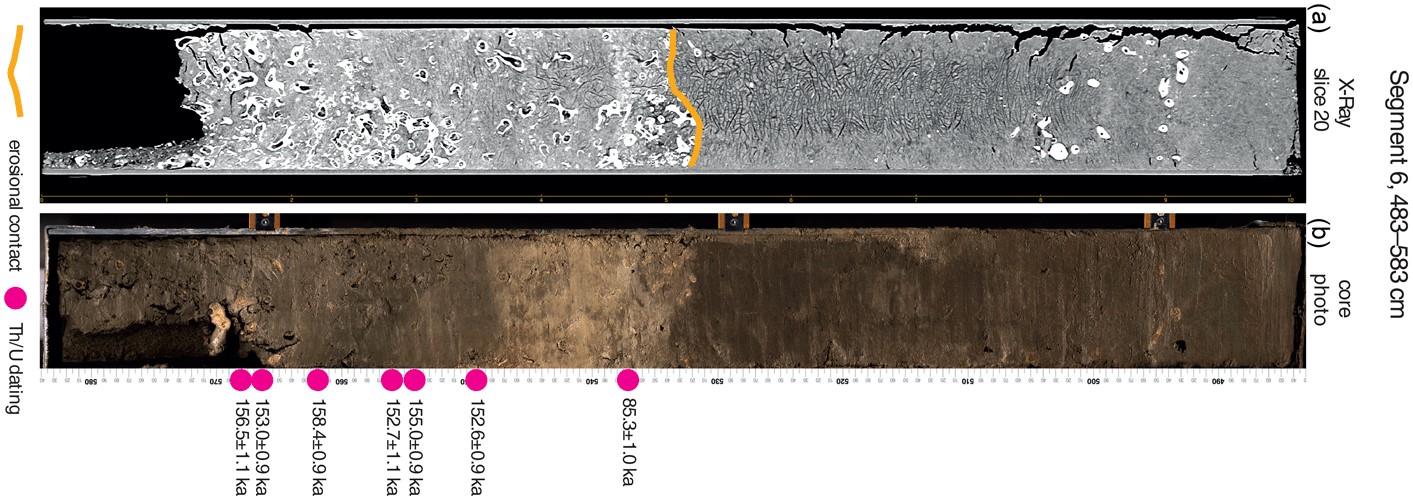
Bahr, A., Doubrawa, M., Titschack, J., Austermann, G., Koutsodendris, A., Nürnberg, D., Albuquerque, A. L., Friedrich, O., and Raddatz, J.
Cold-water corals (CWCs) constitute important deep-water ecosystems that are under increasing environmental pressure due to ocean acidification and global warming. The sensitivity of these deep-water ecosystems to environmental change is demonstrated by abundant paleorecords drilled through CWC mounds that reveal characteristic alterations between rapid formation and dormant or erosive phases ... -
Life in the fluvial hinterland of the late Sarmatian Sea (middle Miocene): a rare terrestrial fossil site in the Styrian Basin (Austria)
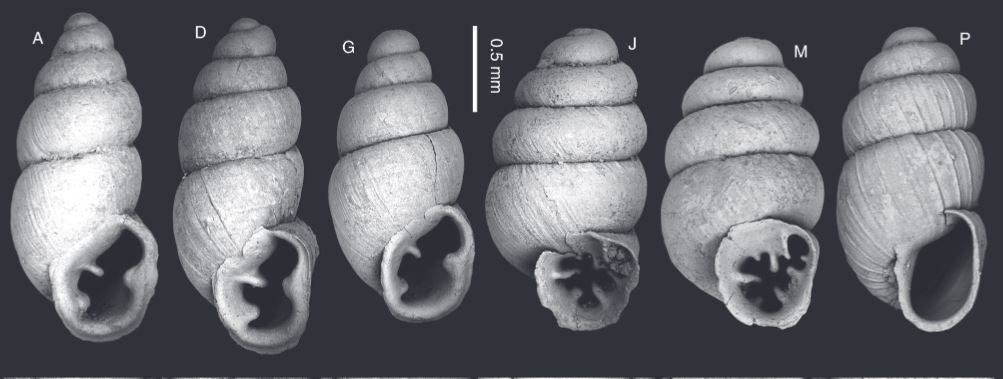
Doubrawa, M., Gross, M., Harzhauser, M.
This paper describes the section and fossil content of a former gravel pit in the Eastern Styrian Basin (SE Austria), which exposes sediments of a fluvial system, ranging from within channel to overbank environments. A predominately terrestrial gastropod fauna of 15 species so far, was recovered from a palaeosol formed in a moist and vegetated, floodplain or abandoned channel ...